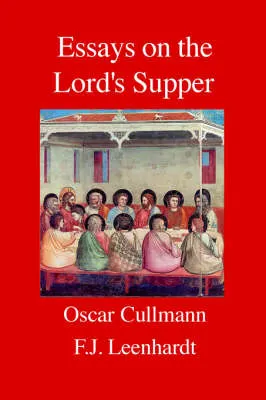
Essays on the Lord's Supper
Oscar Cullmann, F. J. LeenhardtPaperback 2004-06-24
Publisher Description
In these two essays two distinguished Reformed scholars accept the challenge of understanding and explaining the central meaning of the Lord's Supper. How did primitive Christianity understand this event' What relationship was Christ attempting to establish with mankind' Did He wish to establish a link other than the one of preaching His Word' What is the relationship of Word and Sacrament' These and other vital issues for the churches of the Reformation tradition are addressed. In the first essay, Oscar Cullmann proposes to investigate the true meaning of the Lord's Supper with which primitive Christianity invested the cultic act of the sacred meal, as it was practised in the communities of the first century. He examines the Breaking of Bread and the Resurrection Appearances and draws a connection between the Lord's Supper and the Death of Christ, and successfully combines the two in his conclusion. The second essay, by F. J. Leenhardt, provides an answer to the question: What relati
$74.99
$74.99
Click & collect: Select your store
Get information on product availability in store.

.png&w=64&q=75)
.png&w=64&q=75)

.png&w=48&q=75)
Publisher Description
In these two essays two distinguished Reformed scholars accept the challenge of understanding and explaining the central meaning of the Lord's Supper. How did primitive Christianity understand this event' What relationship was Christ attempting to establish with mankind' Did He wish to establish a link other than the one of preaching His Word' What is the relationship of Word and Sacrament' These and other vital issues for the churches of the Reformation tradition are addressed. In the first essay, Oscar Cullmann proposes to investigate the true meaning of the Lord's Supper with which primitive Christianity invested the cultic act of the sacred meal, as it was practised in the communities of the first century. He examines the Breaking of Bread and the Resurrection Appearances and draws a connection between the Lord's Supper and the Death of Christ, and successfully combines the two in his conclusion. The second essay, by F. J. Leenhardt, provides an answer to the question: What relati