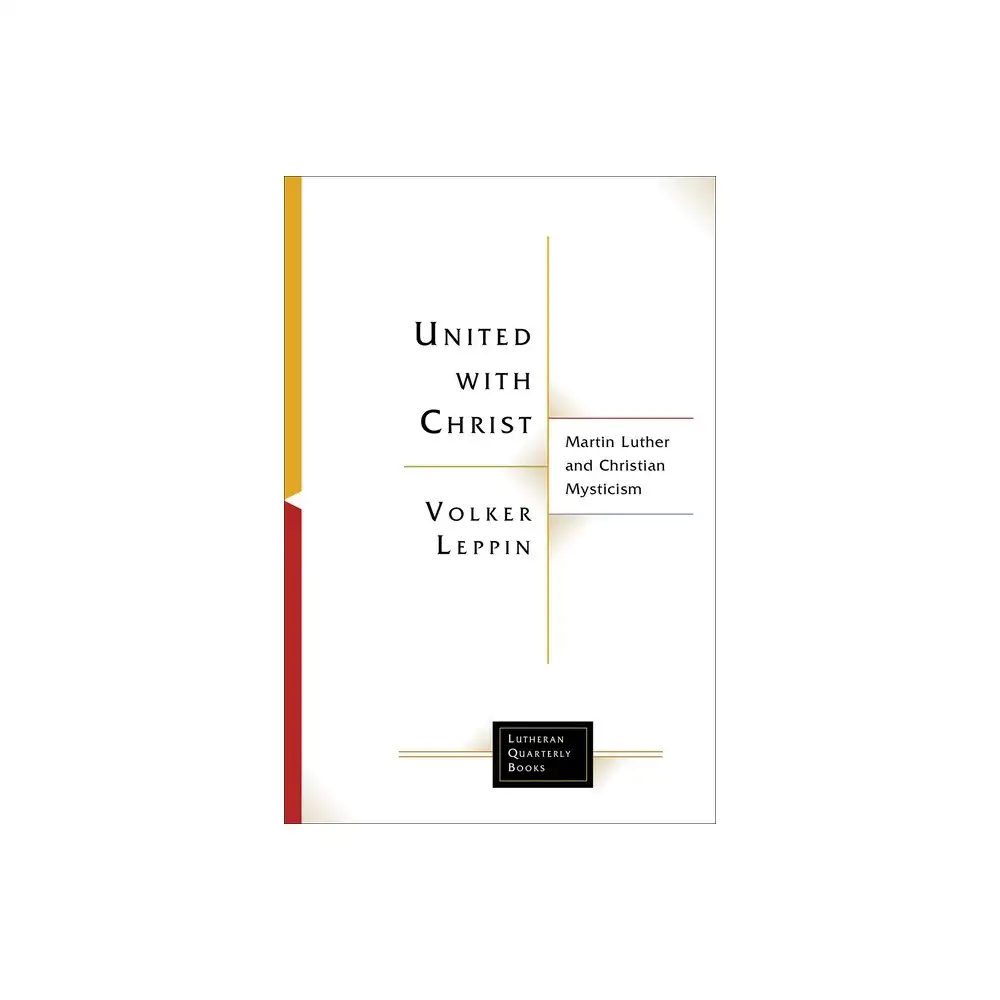
United with Christ: Martin Luther and Christian Mysticism (Lutheran Quarterly Books Series)
Paperback 2025-02-18
Leppin illuminates how Luther's emerging theology drew upon deep wells of personal mystical experience and the guidance of late-medieval mystics such as fourteenth-century priest and theologian John Tauler and others who influenced the reformer's views on a host of theological subjects, including such cornerstones as the Passion and the Eucharist.|<p>In this collection of essays newly published in English, Volker Leppin restores a holistic understanding of Martin Luther's development amid a late-medieval context strongly influenced by mysticism. Far from marking a clean break from earlier ideas, Luther's emerging theology drew upon deep wells of both personal mystical experience and the guidance of earlier mystics. Meister Eckhart's student, the fourteenth-century priest and theologian John Tauler, was an especially important source of inspiration for the young Luther, though he was also an avid student of figures such as Bernard of Clairvaux.</p>
<p>Leppin's careful research overturns conceptions of late-medieval mysticism as inherently works-oriented, illuminating instead how Tauler and others influenced Luther's emerging views on indulgences, the Passion, the Eucharist, and theological tenets including the concepts of law and gospel, justification, and the priesthood of all believers. <i>United with Christ</i> continues to expand upon threads drawn in Leppin's 2024 <i>Sola: Christ, Grace, Faith, and Scripture Alone in Martin Luther's Theology</i>, helping us understand the emergence of the Reformation as an innovative series of developments from, rather than an absolute rupture with, late-medieval Christianity.</p>|<p>In this collection of essays newly published in English, Volker Leppin restores a holistic understanding of Martin Luther's development amid a late-medieval context strongly influenced by mysticism. Far from marking a clean break from earlier ideas, Luther's emerging theology drew upon deep wells of both personal mystical experience and the guidance of earlier mystics. Meister Eckhart's student, the fourteenth-century priest and theologian John Tauler, was an especially important source of inspiration for the young Luther, though he was also an avid student of figures such as Bernard of Clairvaux.</p> <p>Leppin's careful research overturns conceptions of late-medieval mysticism as inherently works-oriented, illuminating instead how Tauler and others influenced Luther's emerging views on indulgences, the Passion, the Eucharist, and theological tenets including the concepts of law and gospel, justification, and the priesthood of all believers. <i>United with Christ</i> continues to expand upon threads drawn in Leppin's 2024 <i>Sola: Christ, Grace, Faith, and Scripture Alone in Martin Luther's Theology</i>, helping us understand the emergence of the Reformation as an innovative series of developments from, rather than an absolute rupture with, late-medieval Christianity.</p>|<p>Introduction</p> <p>1. John Tauler's External Constitution of the Person</p> <p>2. Mystical Piety and Sacramental Mediation of Salvation in the Late Middle Ages</p> <p>3. "omnem vitam fidelium penitentiam esse voluit": Luther's Adoption of Mystical Tradition in his First Thesis on Indulgence</p> <p>4. The Entanglement of Augustinianism and Mysticism in the Late Middle Ages and in the Early Reformational Movement</p> <p>5. Luther's Passion Mysticism</p> <p>6. The Transformation of Late-Medieval Mysticism in Reformational Theology</p> <p>7. Becoming One Bread ("Kuchen"): Mystical Tendencies in Luther's Teachings on the Lord's Supper</p> <p>8. Philosophy of Language, Monastic Meditation, Pnuematic Speech? A Study in Luther's Disputation on the Sentence "Verbum caro factum est"</p> <p>Bibliography</p> <p>Index</p>|<p>Volker Leppin, the leading expert on Martin Luther and medieval mysticism, at last has a book dedicated to the subject in English. This collection of essays establishes itself as the definitive English reference for understanding the mystical aspects of Luther's theology. By reading this book, it becomes increasingly difficult to maintain a strict<em> </em>dichotomy between Protestantism and mysticism, as well as the notion of a sudden breakthrough in Luther's understanding of justification by faith. Instead, Leppin reveals how Luther's early theological development revolved around a mystical transformation of his understanding of penance, shifting from a sacrament mediated by the church hierarchy to a direct and internal encounter with God. Beyond dispelling long-standing stereotypes about Luther, this book has the potential to reshape our contemporary understanding of theology, inviting us to embrace theology not solely as an academic discipline but as an existential orientation. --<strong>Samuel J. Dubbelman, assistant professor of church history, Lutheran Theological Seminary, Hong Kong</strong></p> <p>Volker Leppin's studies of Martin Luther's "mystical roots" and "transformations" of medieval mystical traditions have challenged our historical understanding of the reformer and have major implications for the further development of the Lutheran tradition. This volume makes a judicious selection of Leppin's essays available in English and will be welcome and thought-provoking reading for anyone interested in Luther's theology. --<strong>Vincent Evener, assistant professor in the history of Christianity, Missouri State University</strong></p> <p>Martin Luther transformed medieval Christianity into something else. Some forms were left behind, but their substance endured in difficult-to-see ways. In this deeply learned book, Volker Leppin, one of our finest interpreters of medieval and Reformation Christianity, shares his vision of this transformation. The vision is remarkable both in its microscopic attention to text and context, and also in its breadth of survey of centuries of history. Read this convincing, engaging, and delightful book. --<strong>Derek R. Nelson, professor of religion, Wabash College, and coauthor of <em>Resilient Reformer: The Life and Thought of Martin Luther</em></strong></p> <p>Martin Luther stands at the crossroads of medieval mysticism and early modern university theology. German, American, and Scandinavian scholars interpret Luther's vision in diverse ways. Volker Leppin masters this complex field and provides an academic synthesis that leads the reader to the heart of the Reformation. --<strong>Risto Saarinen, professor, University of Helsinki</strong></p>$47.99$59.99Save $12.00 (20%)
$47.99$59.99Save $12.00 (20%)
Click & collect: Select your store
Get information on product availability in store.

.png&w=64&q=75)
.png&w=64&q=75)

.png&w=48&q=75)
Leppin illuminates how Luther's emerging theology drew upon deep wells of personal mystical experience and the guidance of late-medieval mystics such as fourteenth-century priest and theologian John Tauler and others who influenced the reformer's views on a host of theological subjects, including such cornerstones as the Passion and the Eucharist.|<p>In this collection of essays newly published in English, Volker Leppin restores a holistic understanding of Martin Luther's development amid a late-medieval context strongly influenced by mysticism. Far from marking a clean break from earlier ideas, Luther's emerging theology drew upon deep wells of both personal mystical experience and the guidance of earlier mystics. Meister Eckhart's student, the fourteenth-century priest and theologian John Tauler, was an especially important source of inspiration for the young Luther, though he was also an avid student of figures such as Bernard of Clairvaux.</p>
<p>Leppin's careful research overturns conceptions of late-medieval mysticism as inherently works-oriented, illuminating instead how Tauler and others influenced Luther's emerging views on indulgences, the Passion, the Eucharist, and theological tenets including the concepts of law and gospel, justification, and the priesthood of all believers. <i>United with Christ</i> continues to expand upon threads drawn in Leppin's 2024 <i>Sola: Christ, Grace, Faith, and Scripture Alone in Martin Luther's Theology</i>, helping us understand the emergence of the Reformation as an innovative series of developments from, rather than an absolute rupture with, late-medieval Christianity.</p>|<p>In this collection of essays newly published in English, Volker Leppin restores a holistic understanding of Martin Luther's development amid a late-medieval context strongly influenced by mysticism. Far from marking a clean break from earlier ideas, Luther's emerging theology drew upon deep wells of both personal mystical experience and the guidance of earlier mystics. Meister Eckhart's student, the fourteenth-century priest and theologian John Tauler, was an especially important source of inspiration for the young Luther, though he was also an avid student of figures such as Bernard of Clairvaux.</p> <p>Leppin's careful research overturns conceptions of late-medieval mysticism as inherently works-oriented, illuminating instead how Tauler and others influenced Luther's emerging views on indulgences, the Passion, the Eucharist, and theological tenets including the concepts of law and gospel, justification, and the priesthood of all believers. <i>United with Christ</i> continues to expand upon threads drawn in Leppin's 2024 <i>Sola: Christ, Grace, Faith, and Scripture Alone in Martin Luther's Theology</i>, helping us understand the emergence of the Reformation as an innovative series of developments from, rather than an absolute rupture with, late-medieval Christianity.</p>|<p>Introduction</p> <p>1. John Tauler's External Constitution of the Person</p> <p>2. Mystical Piety and Sacramental Mediation of Salvation in the Late Middle Ages</p> <p>3. "omnem vitam fidelium penitentiam esse voluit": Luther's Adoption of Mystical Tradition in his First Thesis on Indulgence</p> <p>4. The Entanglement of Augustinianism and Mysticism in the Late Middle Ages and in the Early Reformational Movement</p> <p>5. Luther's Passion Mysticism</p> <p>6. The Transformation of Late-Medieval Mysticism in Reformational Theology</p> <p>7. Becoming One Bread ("Kuchen"): Mystical Tendencies in Luther's Teachings on the Lord's Supper</p> <p>8. Philosophy of Language, Monastic Meditation, Pnuematic Speech? A Study in Luther's Disputation on the Sentence "Verbum caro factum est"</p> <p>Bibliography</p> <p>Index</p>|<p>Volker Leppin, the leading expert on Martin Luther and medieval mysticism, at last has a book dedicated to the subject in English. This collection of essays establishes itself as the definitive English reference for understanding the mystical aspects of Luther's theology. By reading this book, it becomes increasingly difficult to maintain a strict<em> </em>dichotomy between Protestantism and mysticism, as well as the notion of a sudden breakthrough in Luther's understanding of justification by faith. Instead, Leppin reveals how Luther's early theological development revolved around a mystical transformation of his understanding of penance, shifting from a sacrament mediated by the church hierarchy to a direct and internal encounter with God. Beyond dispelling long-standing stereotypes about Luther, this book has the potential to reshape our contemporary understanding of theology, inviting us to embrace theology not solely as an academic discipline but as an existential orientation. --<strong>Samuel J. Dubbelman, assistant professor of church history, Lutheran Theological Seminary, Hong Kong</strong></p> <p>Volker Leppin's studies of Martin Luther's "mystical roots" and "transformations" of medieval mystical traditions have challenged our historical understanding of the reformer and have major implications for the further development of the Lutheran tradition. This volume makes a judicious selection of Leppin's essays available in English and will be welcome and thought-provoking reading for anyone interested in Luther's theology. --<strong>Vincent Evener, assistant professor in the history of Christianity, Missouri State University</strong></p> <p>Martin Luther transformed medieval Christianity into something else. Some forms were left behind, but their substance endured in difficult-to-see ways. In this deeply learned book, Volker Leppin, one of our finest interpreters of medieval and Reformation Christianity, shares his vision of this transformation. The vision is remarkable both in its microscopic attention to text and context, and also in its breadth of survey of centuries of history. Read this convincing, engaging, and delightful book. --<strong>Derek R. Nelson, professor of religion, Wabash College, and coauthor of <em>Resilient Reformer: The Life and Thought of Martin Luther</em></strong></p> <p>Martin Luther stands at the crossroads of medieval mysticism and early modern university theology. German, American, and Scandinavian scholars interpret Luther's vision in diverse ways. Volker Leppin masters this complex field and provides an academic synthesis that leads the reader to the heart of the Reformation. --<strong>Risto Saarinen, professor, University of Helsinki</strong></p>